

by Ron Martz
By the time we emerged from the tree line after a grueling climb and saw the top of the hill for the first time, the rest of our group of Vietnam veterans and Vietnamese guides had forged far ahead. They were little more than black dots against the low clouds on the upper reaches of what the Marines in 1968 had named Fire Support Base (FSB) Russell.
The distance to the top from where we stood was much greater and far steeper than the photographs I had seen of it indicated. As we pressed on through the thick, knee-high elephant grass and light drizzle with my son, Chris, urging me on, I had difficulty comprehending how a single company of Marine infantry could defend so much real estate, even with supporting mortars and heavy artillery.
Gone were the ramshackle hooches constructed of logs, dirt-filled ammunition crates, and olive drab sandbags I had seen in war-time photos of the hill. The trench lines and artillery revetments were barely visible after five decades of monsoon rains and erosion. What once was a red scab of churned earth towering above the surrounding jungle war had returned to its lush, pre-war green with little evidence of what transpired here.
We had come to this remote hilltop in Quang Tri Province on September 21, 2019, fifty years to the day since it had been abandoned by the Marines as they were preparing to be pulled out of the war. We came to pay tribute to those who had served there, especially those who had died, and to search for answers and perhaps some clues that would help me solve a mystery that has haunted me for more than forty years.
According to Marine Cops records, shortly after 2 p.m. on September 21, 1969, Marine Lance Corporal James W. Jackson, Jr., of Atlanta, Georgia, suffered a minor back wound as a result of an accidental explosion on FSB Russell. He reportedly was placed on a CH-46 medical evacuation helicopter with several other wounded Marines and taken to the 3rd Medical Battalion hospital at the Quang Tri Combat Base. At that point, he disappeared without a trace. He was never seen or heard from again. He was gone like a wisp of smoke in a strong wind.
I first learned of Jackson’s strange disappearance and the mystery surrounding it in 1983 while researching a story for the Atlanta Journal-Constitution about unresolved cases of prisoners and missing in action from the Vietnam War. At that time, more than 2,500 Americans were still unaccounted for in Southeast Asia. But by then, most of those cases had been re-designated by the government from POW or MIA to KIA-BNR (Killed In Action-Body Not Recovered).
My interest in those unresolved cases stemmed from my service in the Marine Corps from 1965-68, the final fourteen months of which I worked in the Casualty Section at Headquarters Marine Corps (HQMC) in Washington, D.C.
My specific job was handling the paperwork for the personal effects of Marines who had been killed or badly wounded in Vietnam. Occasionally I had to explain to loved ones why the circumstances of their husband’s or son’s death were such that some personal effects, like rings or watches or religious medals, could not be recovered because of the nature of the death. The language we used was, “Due to the circumstances of (Subject Named Marine’s) death, certain items of personal effects were not recoverable.” In none of the cases, however, did we ever reveal that sometimes the remains sent home for closed-casket burials were only fragments of the young men who had gone to war.
A few times files involving the personal effects of Marines missing and unaccounted for came across my desk, but they were routinely filed and I naively thought they would be resolved at war’s end. When the war finally ended in 1973 and the fates of many of the still-missing were not resolved, it sentenced their families to a hellish limbo. The families could not prove their loved ones were alive, but neither could the government prove they were dead.
It was not until the late 1970s, when I was well into my newspaper career, that I learned that many families of men missing in Southeast Asia were still searching for answers as to how and why their loved ones had disappeared and why they, or their remains, could not be brought home. Although I had not served in Vietnam, I felt compelled as a Vietnam-era veteran to tell the stories of those who had been there and not come home. I wanted to make sure the missing and unaccounted for would not be forgotten.
I was fascinated by the Jackson case from the moment I first heard about it, not only because of my time at HQMC, but because it seemed to make absolutely no sense. Someone does not just walk into a hospital and vanish, as the Marine Corps insisted in its investigation had happened. The service with the motto, “We never leave a fallen Marine behind,” seemed to have done just that; they left Jimmy Jackson behind.
“The Marine Corps lost my son,” Jackson’s mother, Rudeen, told me the first time I interviewed her on a cold and rainy February afternoon in 1983.
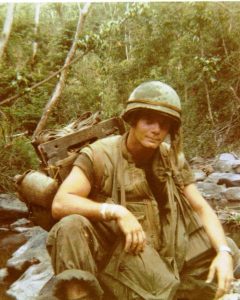
An over-sized boot camp photo of Jackson in his Marine dress blues, along with his medals, dominated one wall of the family’s modest ranch-style home. Jimmy was the third of four Jackson children, but he was special to Rudeen, the only one of her four who did not have a significant health issue.
Jimmy was blessed with a quick wit and a puckish sense of humor that he used to push boundaries of what was legal and what was in good taste. Despite this, no one ever stayed angry with him for long because he was friendly, outgoing, and always seemed to fit in well with whatever group he mingled. There was a likeability about him that enlivened everyone with whom he came into contact.
When he dropped out of junior college in early 1968 and enlisted in the Marine Corps, his mother approved of his decision and told him how proud she was, despite what was going on in Vietnam that year. She watched the news and was aware of the heavy losses the Marines were taking during the Tet Offensive, the battle for Hue, and the siege of Khe Sanh. But she felt that of all the services, the Marine Corps looked out for their men in a special way.
“I was ready for my son to die in Vietnam,” Rudeen said with a sigh as she chain-smoked unfiltered Kool cigarettes and sipped instant coffee as we talked. “I was ready for him to be wounded or captured or any of the things you expect in war. I had prepared myself for all those things because I was the mother of a Marine. But I wasn’t ready for him to be lost without any explanation and that’s just what happened.”
***
On the day Jackson disappeared, his unit was preparing to abandon FSB Russell and pull back to a more secure area in preparation for the Marines’ withdrawal from the war. The hill had been rigged with explosives to bring down all the hooches and to cave in the trenches. As the Marines were waiting for the helicopters to arrive, someone, believed to be one of the two Vietnamese scouts attached to the unit, tossed a lit cigarette into a pile of discarded bags of powder used to propel artillery shells.
A series of explosions rocked the hill and sent Marines scrambling for cover. The helicopters that had been assigned to take the unit off the hill were reassigned to evacuate the casualties. Initial reports indicated at least two Marines were killed and more than a dozen wounded in the explosions.
More than a month passed before anyone realized Jackson could not be accounted for. It was at that point members of his unit, Lima Company, 3rd Battalion, 4th Marine Regiment, got together and tried to reconstruct the events of that fateful day in September.
A Navy corpsman who knew Jackson said he remembered treating him for a minor shrapnel wound and then rode with him and several other casualties on the helicopter to the hospital. Others said they thought they remembered that as well. And that became the prevailing narrative: Jackson had been wounded, had been placed on the helicopter, was taken to 3rd Medical Battalion, and simply vanished.
The official investigation into Jackson’s disappearance did not begin until Nov. 11, 1969, Veterans Day, more than six weeks after the explosion. An Article 32 board (the military equivalent of a grand jury) consisting of three officers, only one of whom was a lawyer, was convened at Dong Ha Combat Base, Quang Tri Province. The orders to the board were to determine what had happened to Jackson and find out who, if anyone, was responsible.
Investigators looked for Jackson at hospitals in Vietnam, Japan, and Okinawa, but there was no record of him being admitted or treated at any of them. The board interviewed dozens of witnesses but was repeatedly hamstrung by events and the time lag between the explosion and the start of the investigation. Several members of the unit who might have provided key testimony had already returned to the states and no effort was made to contact them. There also was increasing pressure to wrap up the case because of the 3rd Marine Division’s tight timeline to leave Vietnam and return to Okinawa.
That time crunch precluded investigators from pursuing two leads that could have solved the mystery before leaving Vietnam. One lead involved human remains seen on the hill two days after the explosion.
According to official records, on September 23, 1969, a unit was sent FSB Russell to complete its demolition. During a cursory search of the hill, two sets of badly burned human remains were seen in the burned-out shell of one of the bunkers. It was assumed by the officer in charge of the operation that day that those remains were of two Vietnamese scouts who had been with Lima Company and could not be accounted for after the explosion. The remains were not examined because unstable ammunition was still cooking off, and no effort was made to recover them. The remains were left where they lay.
When members of the Article 32 board learned of this, they requested permission to return to the hill to try to recover those remains to determine if they were the Vietnamese scouts or Jackson. The request was denied by division headquarters. It was too dangerous, the board was told. It was too time-consuming. It was too speculative and not worth the effort. After all, they needed to get out of Vietnam and could not go hunting a Marine who may or may not have gone AWOL or may or may not have found a local Vietnamese girl to harbor him.
The other lead involved one of dozens of messages flowing between Lima Company, the battalion, and the regiment that day. That one key message, lost in the shuffle for more than 50 years and only recently unearthed from files at Texas Tech University, clearly shows one of the Vietnamese scouts was evacuated from the hill on September 21, 1969. He died either enroute to the hospital or at the hospital.
The Defense POW/MIA Accounting Agency (DPAA), which is responsible for accounting for missing Americans from all wars, now has that message and is reevaluating the case.
But in 1969, the investigative board had not seen that message. So, lacking any concrete evidence that Jackson had either been left behind at FSB Russell or had gotten to the hospital, the board decided to offer no opinion as to his fate. In its official Finding of Facts, it wrote that Lance Corporal James W. Jackson, Jr. simply walked into the hospital and vanished. End of story. End of a life. No explanation.
Jackson was carried as MIA for 11 years, during which he became known to the government as REFNO 1492, a reference number on a file folder indicating his place in the list of prisoners and men missing in Southeast Asia.
In the summer of 1980, the Marine Corps held a hearing to decide whether to continue carrying Jackson as MIA or issue a Presumptive Finding of Death (PFOD). All the services with members still unaccounted were doing the same thing in the aftermath of the war. In every case the burden of proof was on the family members of the missing men. If the families could not prove the men were alive, the government would declare them dead by fiat, not by evidence.
Jackson’s hearing took place at Henderson Hall just up the hill from the Pentagon and across the street from what then was the Navy Annex, where I had been stationed from 1967-68. Jackson was represented by his mother, Rudeen, and her lawyer, a former Army Judge Advocate General attorney.
The lawyer excoriated the Marine Corps and the Department of Defense for their ineptitude in how sloppy and incomplete the investigation had been. His impassioned pleas and Rudeen’s tears mattered little to the lone hearing officer. He was a decorated Vietnam vet thrust into a job he did not care for. That job of clearing cases of Marines missing in Vietnam seemed to worsen the PTSD from which he later admitted he suffered.
The hearing officer asked Jackson’s mother if she had any evidence her son was alive. She had neither the money nor the expertise to investigate anything, much less the disappearance of her son nearly 9,000 miles away. The Marine Corps, and by extension the entire federal government, put the onus was on her to prove her son was not dead. She could not do it.
Although it did not have proof Jackson was dead, the government issued the PFOD. Jackson’s official date of death is August. 7, 1980. Jackson was thirty-two years old when he died, according to the government. To his family, he will forever be 21.
A few months after the PFOD, in a ceremony befitting a military hero, the Marine Corps buried an empty coffin at the Marietta National Cemetery in suburban Atlanta under a headstone bearing REFNO 1492’s name: “Gunnery Sergeant James W. Jackson, Jr.”
Jackson had been promoted and paid while he was missing as if he was still on active duty, rising from E-3 to an E-7 over those 11 years he was in government limbo.
***
After my first meeting with Jackson’s mother, I promised I would do what I could, no matter how long it took, to find the truth about what had happened to her son. I spent years interviewing family, friends, and former Marines who served with Jackson or with other units that had been on FSB Russell and the while trying to convince the government to go back to Vietnam and do a thorough search for his remains at the last place he was definitely know to have been alive.
And, since Jackson was last known alive on that hill, I wanted to see it for myself. I needed to get a sense of it. I wanted to walk the ground that Jackson and his buddies walked and experience this place that has consumed so much of my life for more than forty years. So, on Sept. 21, 2019, two Marines who served with Jackson and I trekked to the site of that long-abandoned hilltop fire support base to pay tribute to him and others who had died there during the 10 months of its existence.
Only one member of our group that made the trip that day actually knew Jackson. Tom Irwin of St. Louis had been Jackson’s bunk mate in boot camp at Parris Island, S.C., in 1968. He fondly recalled how he and Jackson and would talk each other through the tough times in that place in the South Carolina swamps where Marines are made.
Bob Haseman of Helena, Montana, had commanded Lima Company’s second platoon the day of Jackson’s disappearance. Although he did not know Jackson, he wanted to see the hill again and contribute his efforts in the search for the truth about the disappearance.
We spent several hours on the hill that day, taking photos, plotting GPS coordinates, and remembering those who fought and died there. We were neither equipped nor qualified to search for clues, but we felt it important to get a sense of the place and remember what had happened there.
Someone in our group had the foresight to haul along several cans of Huda, a Vietnamese beer, to toast Jackson and all those who served at FSB Russell. We sat in the wet grass on the top of the hill, sipped our beer, and talked about what we knew or remembered of Jackson. We also vowed we could continue pressing the government to find the time and resources to come here, search for his remains, and bring him home.
For the Vietnam vets with me, the trip may have provided a bit of closure in their lives, to see this place that had absorbed so much of their youth. For me, it only strengthened my resolve to do what I set out so many years ago to do: find, and return to his family, the remains of REFNO 1492, James W. Jackson, Jr., USMC. I made a promise to his mother I would find him. I intend to keep that promise.
–
–
–
Ron Martz is a Marine Corps veteran (1965-68) who spent 40 years in the newspaper business as a reporter and editor. He has reported from more than 35 countries and seven wars or regional conflicts. He is the co-author of six books on military history and national security affairs and is at work on a book about his search for REFNO 1492.
–
–
–